
Systeme.io Free Plan vs Paid Plan-Should You Upgrade?
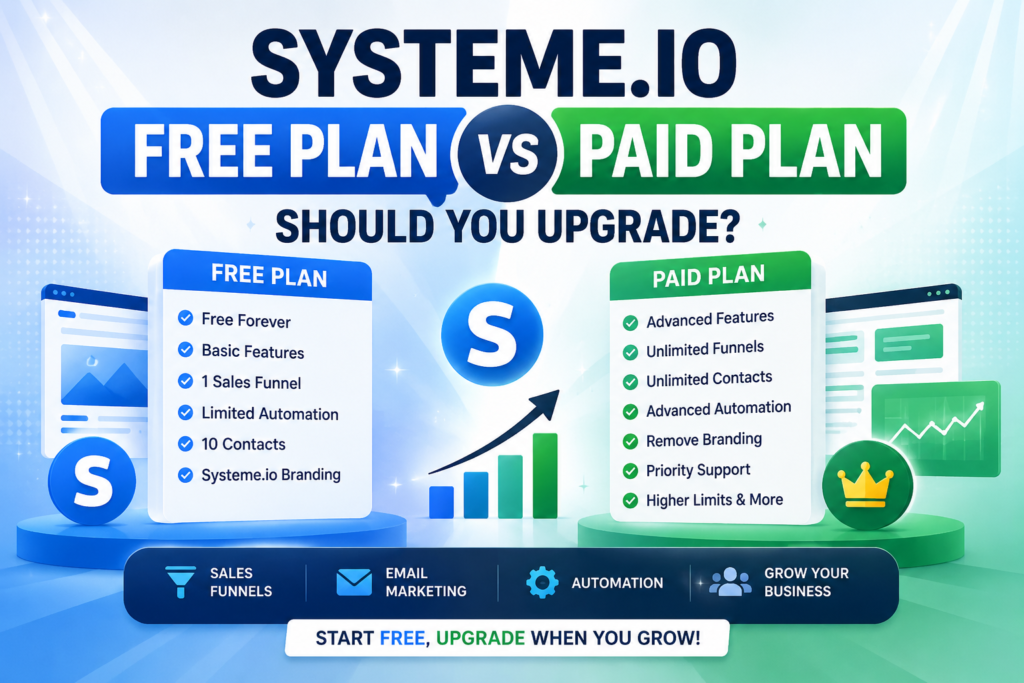
You found Systeme.io. You liked that it doesn’t ask for a credit card. You built a funnel, sent a few emails, and now you’re staring at a pricing page wondering if you actually need to pay for anything.
Good question. Most marketing tools want your money before you’ve proven their tool is worth it. Systeme.io flips that script you can run a real business on the free plan before you ever open your wallet. But “free” always has a ceiling somewhere. This article breaks down exactly where that ceiling is, what each paid tier unlocks, and how to tell when you’ve actually outgrown the free version instead of just feeling like you have.
What the Free Plan Actually Gives You
Let’s start with the obvious question: is the free plan a real product, or is it a 14 day trial wearing a disguise?
It’s real. Systeme.io’s free plan never expires and doesn’t require a credit card to sign up. That alone puts it ahead of most “free trials” in this space, which quietly convert to paid subscriptions the moment you forget to cancel.
Here’s what’s included:
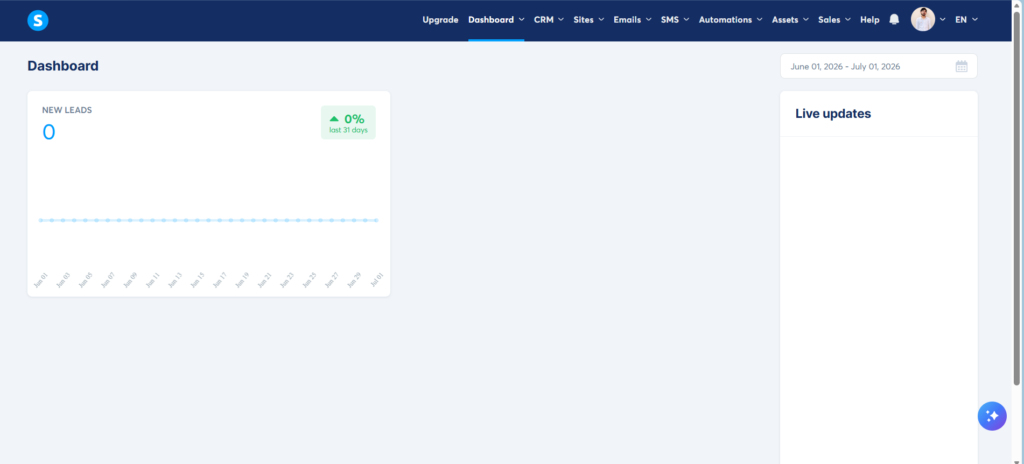
- 2,000 contacts in your email list
- 3 sales funnels
- 1 course
- 1 blog
- 1 affiliate program
- 1 custom domain
- Unlimited emails and unlimited file storage
That last point deserves a pause. A lot of free email tools cap how many emails you can send per month. Systeme.io doesn’t. You could have 500 subscribers and blast them daily without hitting a wall. The only real constraints on the free tier are the number of funnels, courses, and contacts not how much you can actually do with them.
For comparison, building the same stack elsewhere would mean paying for a funnel builder, an email platform, a course host, and an affiliate tool separately. One breakdown estimated a comparable setup ClickFunnels for funnels, Mailchimp for email, Teachable for courses, and an affiliate tool on top would run around $245 a month before you even connect them together. Systeme.io bundles all of that for free, at least up to the limits above.
So why would anyone pay? You can check the free plan out yourself here – it takes about 90 seconds to create an account.
What Changes When You Upgrade
Systeme.io has three paid tiers, and honestly, they’re not trying to trick you into upgrading every few weeks. Each one solves a specific bottleneck.
Startup Plan $17/month
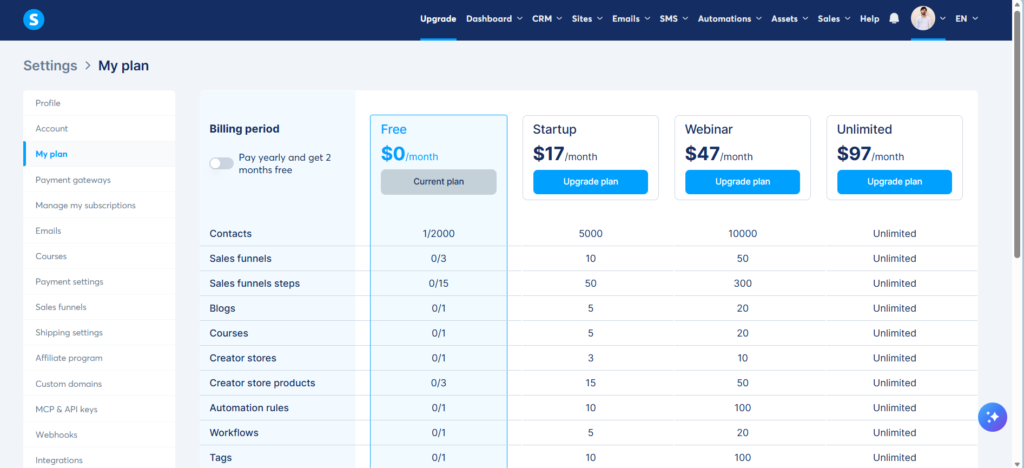
This is the plan most people land on when the free tier starts pinching. It bumps your contact limit to 5,000, gives you unlimited funnels instead of just three, and unlocks up to 5 courses. If your only complaint about the free plan is “I need one more funnel” or “I’m about to hit 2,000 subscribers,” Startup solves it without overpaying for features you won’t touch.
Webinar Plan $47/month
This tier is built around one feature: automated (evergreen) webinars. If you sell through live or pre-recorded webinar funnels, this is where that functionality lives it doesn’t exist on Free or Startup at all. You also get 10,000 contacts and unlimited everything else. One detail worth knowing: the ability to run your own affiliate program with recruited affiliates is also gated to this tier and above, not just the branded webinar tools.
Unlimited Plan $97/month
No contact caps. No funnel caps. No course caps. You also get the ability to create sub-accounts, which is the plan agencies and consultants pick when they’re managing multiple client businesses under one login. It includes a free migration service too, which matters if you’re dragging years of funnels and email sequences over from another platform and don’t want to do it by hand at 1 a.m.
Annual billing on any paid plan gives you roughly two months free compared to paying monthly worth doing once you’re confident you’re staying.
The Honest Math: When Free Stops Being Free
Here’s the part most comparison articles skip: what actually happens when you outgrow the free plan and don’t upgrade?
Your contacts over the 2,000 limit don’t get deleted. They get archived. They’re not lost, but they’re locked away and unreachable until you upgrade to a paid tier and reactivate them. So if you’re closing in on that number, the decision isn’t really “should I upgrade” it’s “do I want to keep talking to the subscribers I already have.”
That’s a fair trade, honestly. Nobody’s holding your data hostage. But it does mean the free plan has a natural expiration date tied to your own growth, even if the plan itself never technically expires.
Should You Upgrade? A Simple Way to Decide
Skip the spreadsheet. Ask yourself these questions instead:
Are you under 2,000 contacts and running fewer than 3 funnels? Stay free. Paying now buys you nothing you’re actually using.
Are you bumping against the funnel or course limit, but your list is still small? Startup at $17/month is the obvious move. It’s cheap enough that the math barely matters.
Do you run webinars, or do you need your own affiliate program with recruited partners? You need Webinar or higher this isn’t optional, since that functionality simply doesn’t exist below it.
Are you managing more than one business or client account? Unlimited is built for exactly this. Sub-accounts alone can justify the price if you’re running an agency.
What Real Users Say (The Good and the Blunt)
No plan comparison is complete without the messy parts, so here’s the balanced version.
On the upside, users consistently point to the value one small business owner running marketing, funnels, and course sales in one dashboard, without juggling five separate subscriptions. Several reviewers highlight the free plan specifically as generous compared to competitors that charge $30–$50 a month for similar core features.
On the downside, a recurring complaint is design flexibility. Templates are functional, not flashy expect to spend more time on copy and offer strategy than obsessing over pixel-perfect page design. Support response times also come up as inconsistent, with some users reporting quick help and others reporting waits. Neither extreme should be your only data point, but it’s worth knowing going in.
None of this changes the pricing math. It just means Systeme.io trades some design polish and support speed for cost savings a trade a lot of early-stage founders are happy to make.
The Bottom Line
The free plan isn’t a gimmick. It’s a genuinely usable business tool, and plenty of people run real income streams on it without ever paying a cent. Upgrade only when a specific limit is actually blocking you not because a pricing page made $17 a month feel inevitable.
If you’re testing an idea: stay free. If you’re growing past 2,000 contacts or need more funnels: Startup. If webinars or affiliate recruiting are part of your strategy: Webinar or Unlimited. If you’re running an agency: Unlimited, and don’t think twice about it.
Start where your business actually is today, not where you hope it’ll be in six months. Systeme.io makes that easy upgrading takes two clicks whenever you’re ready.
👉 Create your free Systeme.io account here no credit card, no time limit, just the tool.
Sources:
Systeme.io Official Pricing Page
Systeme.io Pricing Breakdown — ThatMarketingBuddy
Systeme.io Pricing & Review — Ruzuku
Systeme.io Reviews & Pricing — Software Finder
Systeme.io vs ClickFunnels: Which Funnel Builder Is Better in 2026?